TVU Networks and vivo unveil TVU Pocket, a phone-sized broadcast device combining dual active 5G, dual Wi-Fi, TVU’s ISX bonding technology and direct cloud production connectivity....
Eight Cities, Four Provinces, One Broadcast: The “Northeast Super” Kicks Off, Powered by TVU Cloud Production
TVU powered the full cloud-based broadcast of China's new "Northeast Super" football league — 34 matches across 4 provinces and 8 cities, with 44 concurrent HD outputs delivered from pitch to national broadcast.
View Related ProductsIn early summer 2026, China’s grassroots sports scene gained a notable new fixture. The Northeast City Football League—known in the industry simply as the “Northeast Super”—was launched jointly by three provinces (Liaoning, Jilin, and Heilongjiang) and the Inner Mongolia Autonomous Region. By pooling resources across administrative boundaries rather than running separate local competitions, the four regions set out to broaden participation in amateur football.
The inaugural season brought together eight city sides—Shenyang, Dalian, Changchun, Yanbian, Harbin, Jixi, Hohhot, and Tongliao—across a regular season and a knockout stage. Play began on 23 May and runs through to the finals in October.
A tournament spanning four provinces, stretched over more than half a year, with match sites scattered far and wide, places unusually heavy demands on broadcasting. The coverage had to satisfy the technical standards of China’s national broadcaster, CCTV, while simultaneously feeding a growing roster of digital and streaming platforms. This was never a single-venue broadcast; it was a large, live-orchestrated network of feeds that had to be deployed and managed in the cloud.
TVU handled signal transport and multi-platform distribution for the entire season, building a solution that pairs traditional broadcast production with a lightweight digital workflow—all centered on cloud production.
Three challenges, stacked on top of one another
Massive concurrent distribution. The system had to support 34 matches in total. Each match meant five HD input feeds fanning out to 44 HD output feeds, with every one of those 44 outputs transcoded independently. A stutter or mismatch on any single feed risked being amplified at once across dozens of downstream recipients.
Geographic spread versus link reliability. The eight teams were spread across Changchun, Shenyang, Harbin, Dalian, and other host cities, with on-site conditions varying considerably from venue to venue. Getting every feed up to the cloud reliably and with low latency was the first hurdle.
A diverse, protocol-mixed set of recipients. The final destinations included CCTV’s sports channel, its digital platform, Jiangsu Television, the municipal stations across the four northeastern regions, and digital players such as Tencent, Beidou Cloud, and Litchi Cloud. Traditional broadcasters work in SDI; digital platforms prefer IP streams. Some recipients had TVU receivers on hand; others could only pull a feed via RTMP or SRT. A single solution had to “speak” all of these languages at once.
Taken together, these demands made the Northeast Super broadcast a composite problem: high concurrency, wide coverage, multiple protocols, and high reliability, all at the same time.
Why TVU cloud production
The most straightforward reason is that the approach is field-proven. This cloud-production solution had already served a string of provincial grassroots tournaments—including amateur basketball and football leagues in Zhejiang, Jiangsu, Sichuan, Jiangxi, and Yunnan—each a real-world stress test. The Northeast Super design built directly on that experience, tailored to the league’s particular reach across four provinces and eight venues. The production team wasn’t handed an experimental sketch but a mature plan with ample built-in redundancy.
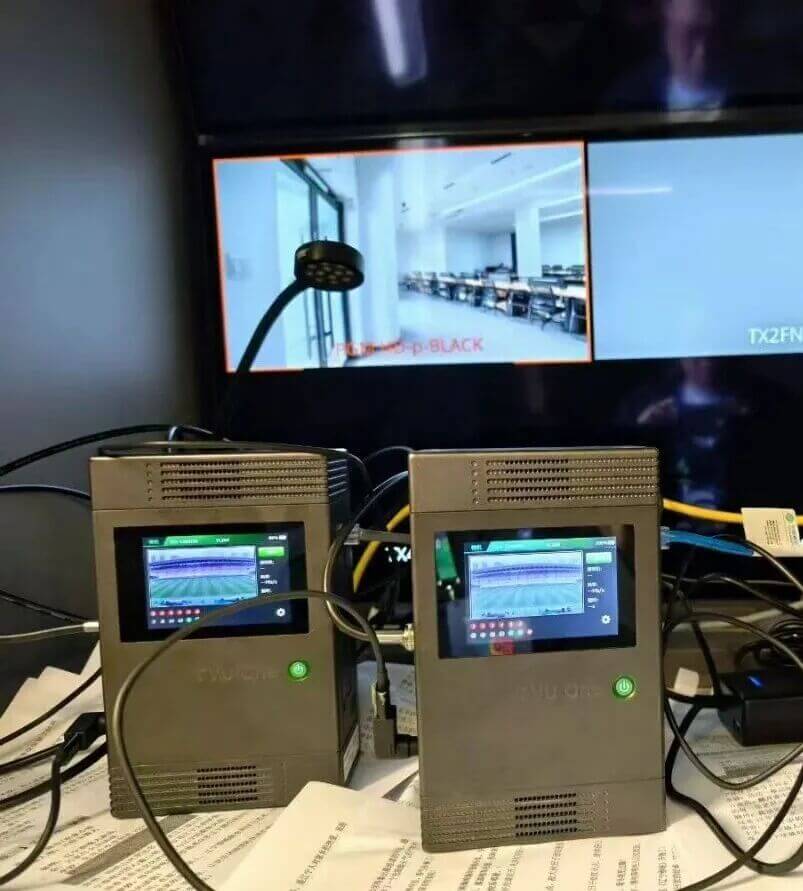
Just as important, TVU controls the complete signal chain end to end: the TVU One 5G live backpack at the front end, the TVU MediaHub cloud orchestration platform in the middle, and TVU’s proprietary ISSP streaming protocol tying it together. Together these turn the full “to the cloud, produce, back from the cloud” workflow into a single integrated pipeline—the core difference between this approach and conventional outside broadcasting.
A signal’s journey through the cloud
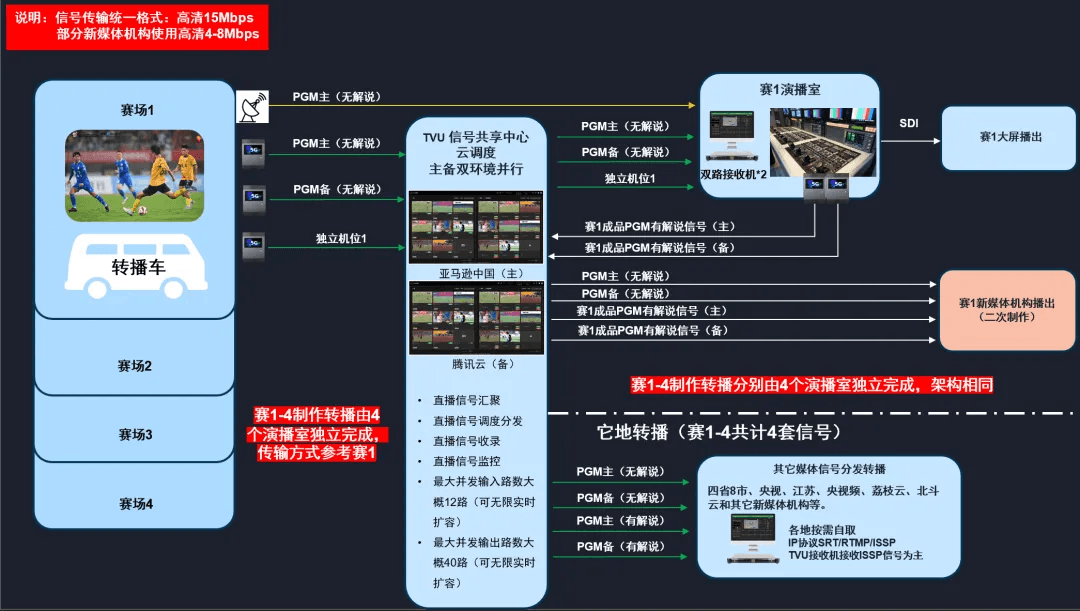
1. On-site capture and multi-link aggregation to the cloud. Once each venue’s OB truck completed its on-site production, the signal was sent up to the cloud over two parallel channels via the TVU One 5G backpack. The clean program feed (without commentary) was uploaded alongside an independent camera feed, with the backpack’s multi-network bonding providing stable, redundant transport.
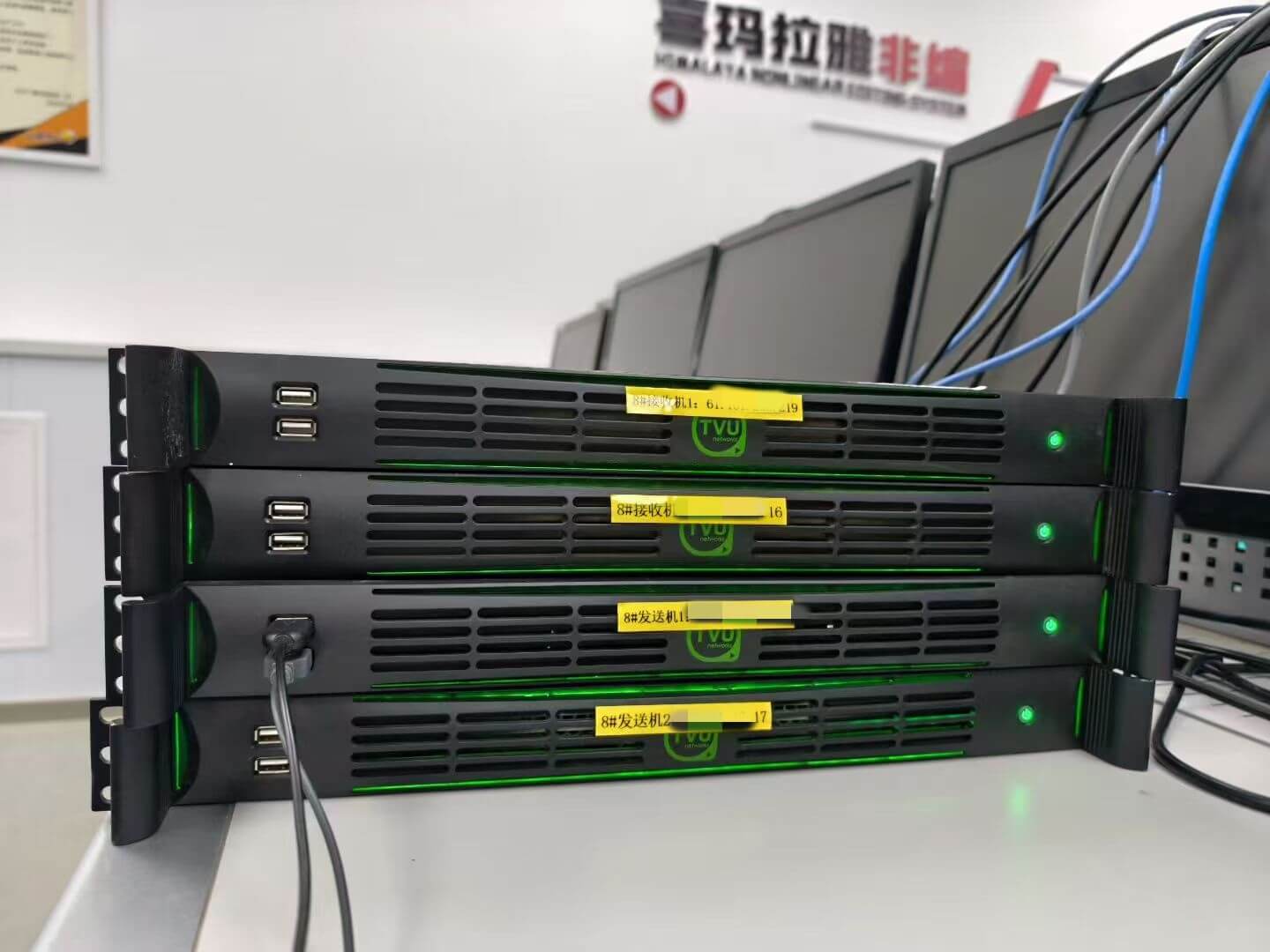
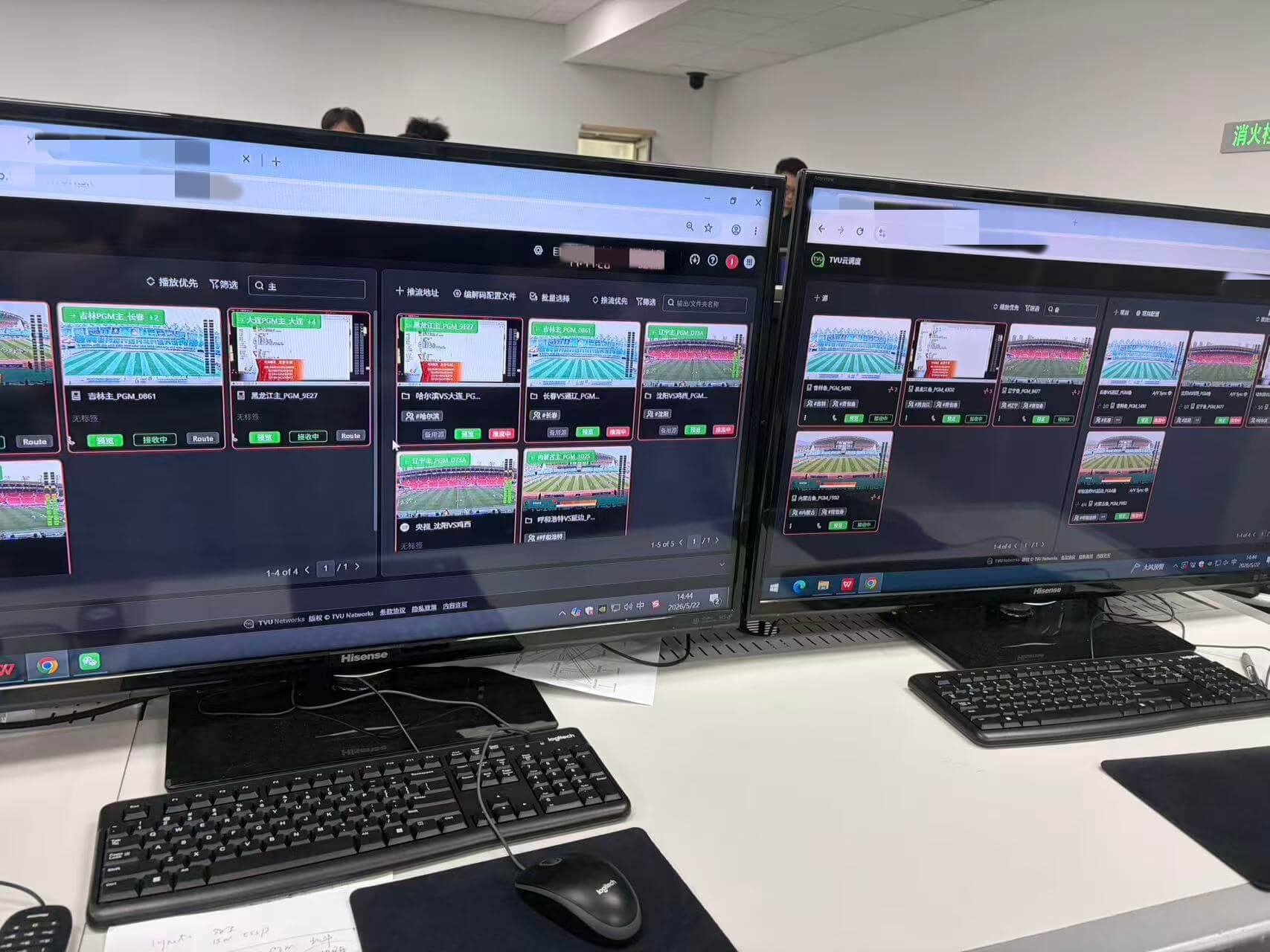
2. Cloud aggregation and dual-environment production. All uploaded feeds converged at TVU’s signal-sharing hub, managed centrally by TVU MediaHub. The platform ran on Tencent Cloud and Amazon Web Services as a primary-and-backup pair—both live simultaneously and mutually redundant—handling aggregation, scheduling, recording, and monitoring, and performing transcoding in the same step. In effect, the production nerve center moved out of the machine room and into the cloud.
3. Studio finishing and return feed. Scheduled feeds were routed to the production studios, where dual TVU receivers were used to add commentary and finish the program. The finished program feed (a primary and a backup) was then sent back up to the cloud and, in parallel, delivered to broadcasters over SDI. Four studios served the four match regions, each running an identical setup.
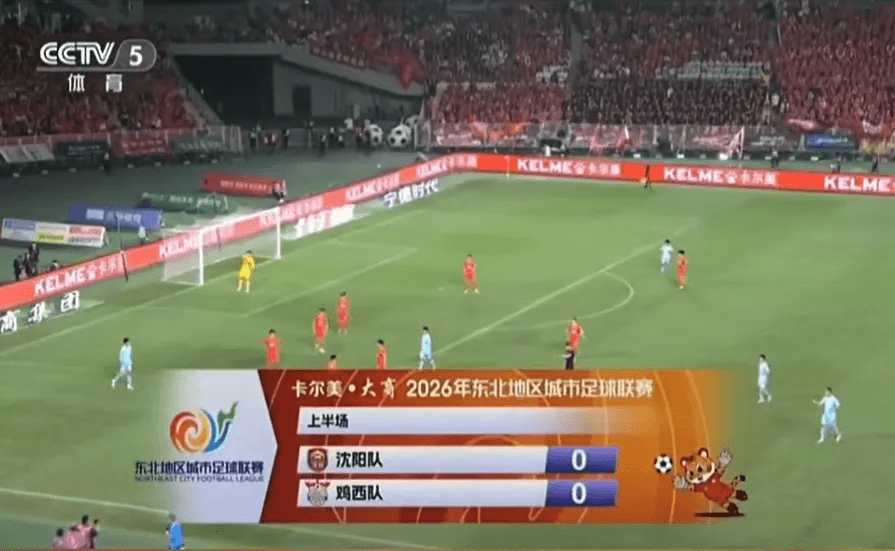
4. Multi-protocol, multi-destination distribution. Cloud orchestration then pushed the signal out to each recipient: those with TVU receivers took it via the ISSP protocol, while those without pulled it via RTMP or SRT, each as needed. The feed reaching CCTV’s sports channel was delivered through this same cloud orchestration layer.
A signal that began at a stadium somewhere in Northeast China traveled up to the cloud, through scheduling, production, and distribution, and finally reached screens of every size—the entire route running through the cloud, cleanly and smoothly.
Three problems, three solutions
Elastic orchestration for high concurrency. Five inputs, 44 outputs, independent transcoding, and the ability to scale in real time—TVU MediaHub’s visual, drag-and-drop interface reduces an otherwise tangled signal matrix to something manageable. This near-limitless flexibility in distribution is precisely what a physical, hardware-based routing matrix struggles to match.
Redundancy and seamless failover for wide, reliable coverage. A dual-cloud foundation eliminates single points of failure at the infrastructure layer; the 5G backpack’s “one primary, two backup” configuration adds another layer on the transport side; and the proprietary ISSP protocol keeps primary and backup cloud feeds in sync, allowing seamless failover. If the primary path falters, the system switches to the backup without a black screen or any visible interruption. For a tournament being carried on national-broadcaster channels, this kind of redundancy is the baseline, not a nice-to-have.
Universal format support for the protocol problem. The input side accepts virtually every mainstream format—HTTP, RTMP, ISSP, SRT, and more—and the output side supports multi-protocol streaming just as readily. A single system can serve SDI-based traditional broadcasters and IP-stream-oriented digital platforms alike, delivering genuine all-media coverage.
Setting a higher bar
For years, broadcasting a major event meant leaning heavily on satellite trucks, microwave links, and dedicated lines—capital-intensive, geographically anchored infrastructure where each new distribution point meant building out another full physical chain, at high cost and over long lead times. Faced with the new wave of grassroots, regional, multi-venue events, that traditional model simply can’t keep up.
The Northeast Super is a textbook example of this new kind of competition, and it was a fresh test of TVU’s cloud-production framework at scale: four provinces, eight cities, 34 matches, 44 concurrent output feeds, and national-level broadcast delivery. A successful opening round validated more than a single production plan—it validated a repeatable, scalable model for how events can be broadcast.
When production moves to the cloud, and a 5G backpack can turn any venue into a live origination point, the barrier to broadcasting sport drops sharply. With the cloud as the main stage for moving signals, every pitch and every team has a real chance to be seen. Broadcasting sport is becoming more flexible, more reliable, and more widely accessible than ever before.
