Ferrari Team Principal Frédéric Vasseur joined a live-commerce broadcast from Ray-Ban's Shanghai flagship store days before the 2026 F1 Chinese Grand Prix, with TVU One backpacks ensuring a seamless multi-platform stream in a technically challenging urban environment....
Racing Against the Signal: How TVU Conquered India’s Most Challenging Live Broadcast
TVU's Integrated Solution Powers the Inaugural Bajaj Pune Grand Tour—From Motorcycle Shots to LEO Satellite Transmission
View Related ProductsCUPERTINO, Calif., Jan. 30, 2026 — From January 19–23, 2026, India’s inaugural Bajaj Pune Grand Tour thundered through Maharashtra over five remarkable days, marking a watershed moment in the professionalization and internationalization of Indian cycling. This wasn’t merely a race—it was a statement of ambition. Top domestic and international cyclists navigated punishing terrain while broadcast teams faced an equally formidable challenge: delivering world-class live coverage across some of the most technically demanding conditions imaginable.
The Challenge: When Terrain Meets Technology
Large-scale multi-regional tour events push broadcast infrastructure to its absolute limits. The Pune Grand Tour proved no exception.
The race route carved through Maharashtra’s diverse landscape—from urban centers to remote stretches and hilly terrain where cellular towers are sparse luxuries rather than reliable infrastructure. In many locations, network bandwidth limped along at just 15–20 Mbps, a fraction of what traditional broadcast operations typically require.
The production demands were uncompromising: seamless coordination between ground-based mobile coverage, sweeping aerial shots, and fixed camera positions—all under network conditions that would normally force compromises in quality or reliability. The team confronted three critical imperatives simultaneously. First, maintaining signal transmission stability during high-speed mobile scenarios with severely constrained bandwidth. Second, managing and distributing multiple video feeds in real time without delays or dropouts. Third, delivering synchronized, broadcast-quality content to both domestic Indian platforms and international broadcasters.
Failure wasn’t an option. Neither was mediocrity.
TVU’s Integrated Solution: Engineering Excellence at Every Point
Following comprehensive technical evaluation and rigorous field verification, the production team deployed a complete TVU ecosystem designed to address every transmission challenge:
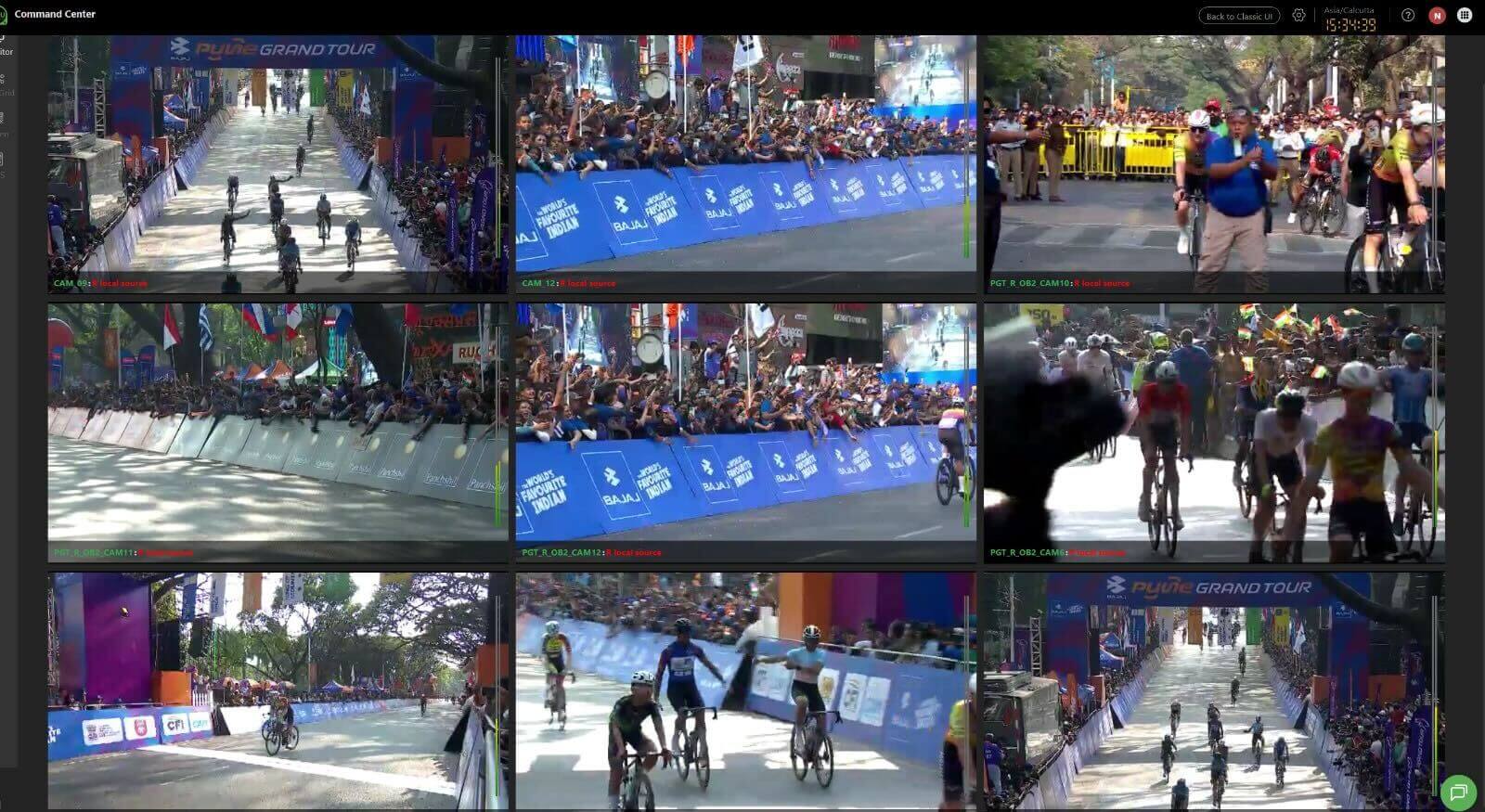
- 16 TVU One units mounted on motorcycles and follow vehicles, capturing and transmitting real-time high-quality mobile footage from the heart of the peloton
- 4 TVU MLink systems deployed within mobile production trucks, relaying vehicle-mounted signals via Low Earth Orbit (LEO) satellite to master control
- 13 TVU GLink devices positioned strategically at start and finish lines, key turning points, fixed vantage positions, and drone mounts for pristine signal return
- TVU MediaHub distributing the finished program feeds to multiple domestic and international broadcast platforms via SRT protocol
Together, these components formed an interconnected broadcast nervous system—flexible enough to adapt to changing conditions, robust enough to never falter.
Core Technology Deep Dive
TVU One: Mobility Without Compromise
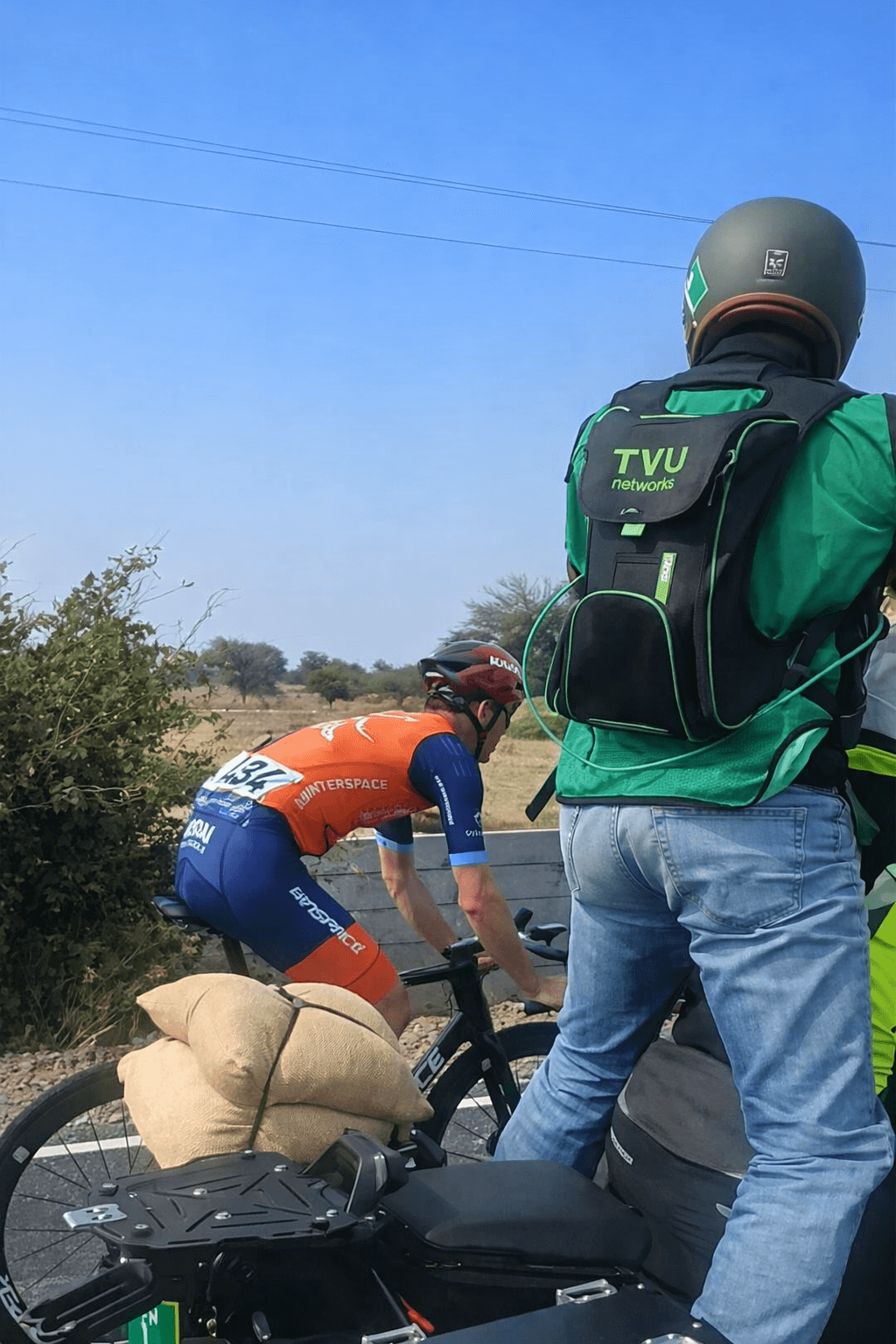
At the heart of the mobile coverage operation, the deployed TVU One backpacks integrate TVU’s latest ISX multi-link bonding transmission technology. This sophisticated system simultaneously harnesses 5G, 4G, satellite, and WiFi networks, intelligently distributing video and audio data across all available pathways in real time. When one link experiences fluctuations or dropouts, the system instantaneously adjusts its data distribution strategy, ensuring uninterrupted picture transmission without perceptible quality degradation.
The results spoke for themselves. Sixteen TVU One units, deployed on motorcycle follow vehicles weaving through the peloton, consistently delivered crisp, fluid race footage to master control—even while navigating high-speed pursuits through technically complex mobile scenarios. Viewers experienced an immersive perspective: the sensation of riding alongside competitors, feeling the race unfold in real time.
What made this possible in bandwidth-starved environments? The advanced configuration proved decisive. Each unit featured all 5G modems paired with MIMO (Multiple-Input Multiple-Output) antenna technology, extracting maximum performance from whatever network infrastructure existed—however limited. Remote mountain passes and elevated terrain that would cripple conventional broadcast setups became merely another challenge overcome.
TVU MLink: Production Truck Connectivity Reimagined
TVU MLink represents broadcast engineering refined into a 1RU rack-mounted form factor, purpose-built for mobile production trucks and studio environments. The unit employs the same battle-tested ISX multi-link bonding technology as TVU One while supporting external antennas to ensure optimal signal acquisition regardless of vehicle position or terrain.
Throughout the race, four MLink units transformed mobile production trucks into fully connected broadcast hubs. Vehicle-mounted camera signals traveled to master control at uncompromising broadcast quality via LEO satellite—a transmission pathway immune to the terrestrial network limitations plaguing ground-based alternatives. The systems supported multiple HD and UHD formats with sub-second latency, providing the stable, reliable foundation upon which production crews could confidently build their coverage.
TVU GLink: Point-to-Point Precision
Where fixed camera positions and aerial perspectives demanded absolute reliability, TVU GLink delivered. This IP-based point-to-point video transmission platform achieves high-quality, low-latency connections between two points through a combination of ISX multi-link bonding technology and HEVC VBR encoding—a pairing that maintains rock-solid transmission even when network conditions deteriorate.
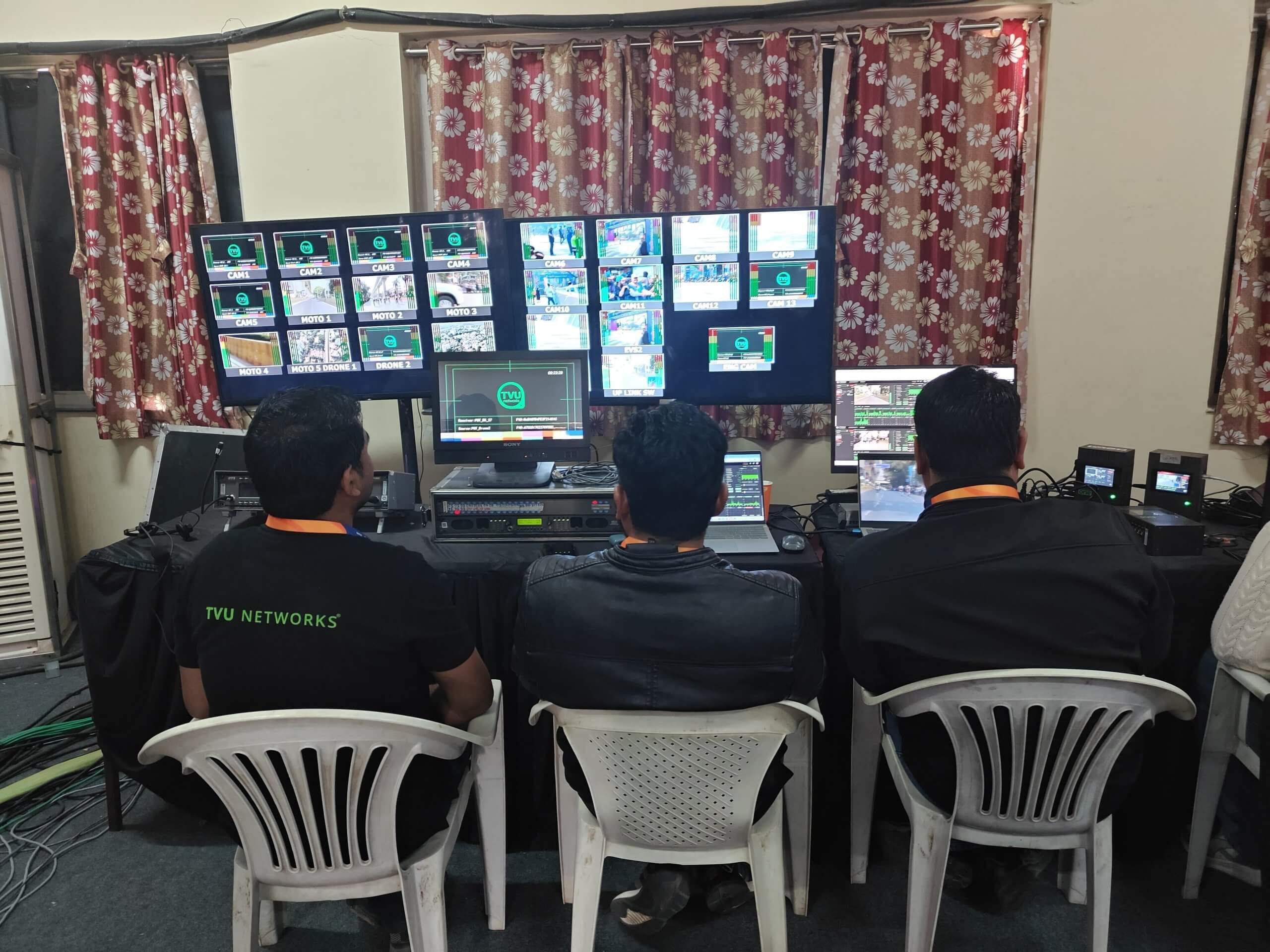
Thirteen GLink units anchored the production’s fixed infrastructure. Start lines buzzed with anticipation; finish lines captured triumph and exhaustion; key turning points revealed tactical battles; drone mounts provided sweeping aerial context. Every position achieved studio-grade signal quality, ensuring that no critical moment escaped capture—from breakaway attempts on remote hillsides to sprint finishes in crowded urban stretches.
TVU MediaHub: One Signal, Many Destinations
The final piece of the puzzle resided in the cloud. TVU MediaHub served as the centralized media nerve center, receiving the finished program signal from master control and distributing it outward to hungry platforms worldwide.
For this event, MediaHub employed SRT protocol to deliver programming simultaneously to multiple Indian domestic broadcasters and international platforms—all with low latency and unwavering quality. The system effectively neutralized the twin nemeses of network jitter and packet loss while maintaining transmission security throughout. What once required complex, expensive infrastructure now flowed seamlessly through a cloud-based solution: efficient one-to-many distribution, elegantly executed.
Five Days of Flawless Execution
Throughout the five-day broadcast production, TVU’s integrated solution performed with remarkable consistency. The statistics tell one story; the seamless viewer experience tells another.
Motorcycle follow shots captured the raw energy of competition. Mobile truck LEO satellite transmission maintained connectivity where terrestrial networks couldn’t reach. Fixed camera positions at start and finish lines framed each day’s drama with precision. Drone aerial footage, returned via point-to-point GLink connections, provided breathtaking perspective on Maharashtra’s landscapes. Master control PGM signals flowed outward through MediaHub to platforms across India and beyond.
The entire system operated as a unified whole—each component supporting the others, adapting to conditions, never compromising on quality. Viewers experienced seamless race coverage: compelling, professional, and uninterrupted from start to finish.
Setting a New Standard for Sports Broadcasting
The successful implementation of this project accomplished more than delivering professional-grade live production for India’s first Pune Grand Tour. It established a technical benchmark—a proof of concept demonstrating what’s possible for multi-camera remote production of sporting events across challenging terrain and infrastructure-limited regions.
The demands on sports broadcasting continue to evolve. Events require greater mobility, enhanced flexibility, and rigorous cost control. Traditional approaches struggle to deliver on all three simultaneously.
TVU’s IP and cloud-based solutions for transmission, production, broadcast, and distribution address this convergence of demands directly. The Pune Grand Tour demonstrated these capabilities under pressure—and the system delivered without qualification.
As global sports events seek broadcast partners capable of matching ambition with execution, the path forward has never been clearer. The future of sports live production runs through integrated, intelligent, adaptable broadcast infrastructure.
The Pune Grand Tour proved it. TVU built it.
