The integration will make its Latin American debut with a live demonstration at the booth of CIS Group, a strategic advisor and systems integrator specializing in media operations, at SET Expo 2026....
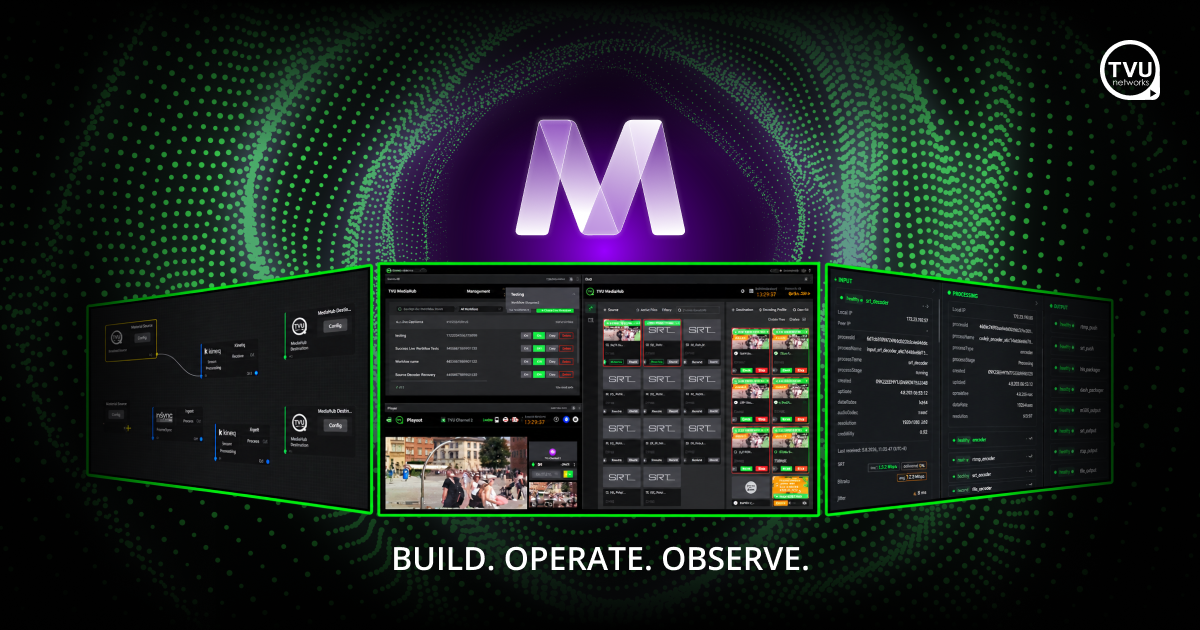
TVU Networks Introduces MediaMesh® Platform Tools to Make Software-Defined Live Production Economically Practical
TVU Networks has announced the Limited Availability release of TVU MediaMesh® Platform Tools — MediaMesh Build, Operate and Observe — a suite of tools designed to make software-defined live production economically practical at enterprise scale. Announced at IBC2026, the tools target the hidden engineering costs of configuring, deploying, operating and troubleshooting complex live media workflows across cloud, on-premises and hybrid infrastructure.
View Related ProductsMediaMesh Build, Operate and Observe reduce the hidden engineering cost of configuring, deploying, operating and troubleshooting complex live media workflows, while preserving the performance and reliability required for professional production.
AMSTERDAM — IBC 2026 — TVU Networks today announced the Limited Availability release of TVU MediaMesh® Platform Tools, a suite of customer-facing tools designed to make the flexibility and infrastructure economics of software-defined live production practical at enterprise scale.
The release includes three tools: MediaMesh Build, MediaMesh Operate, and MediaMesh Observe. Together, they allow media organizations and systems integrators to visually construct software-defined workflows, create purpose-built operational environments, and monitor and troubleshoot complex media systems across cloud, on-premises and geographically distributed infrastructure.
Software and cloud infrastructure have transformed the economics of computing. But in live media, inexpensive compute does not necessarily mean an inexpensive workflow. The engineering required to configure connections, deploy applications, integrate multiple vendors, monitor hundreds of signals and diagnose failures can dwarf the underlying infrastructure cost.
In TVU primary research across live production organizations, a representative 90-minute cloud live production required approximately $15 of compute infrastructure but $890 of specialist engineering configuration. The infrastructure is nearly free. The expertise is not.
MediaMesh Platform Tools are designed to change that equation.
MediaMesh Build gives customers and systems integrators a no code graphical environment for composing and deploying custom workflows from a growing library of TVU, third-party and industry-based software components. MediaMesh Operate lets organizations assemble purpose-built workspaces from reusable applications and widgets so operators see the controls they need and information appropriate to their job rather than the underlying complexity of the system. MediaMesh Observe provides a unified operational view across large numbers of signal paths and distributed software processes, helping teams identify and troubleshoot issues without manually correlating data across infrastructure and vendors.
TVU is also applying AI to one of the most difficult operational problems in modern IP media: turning enormous volumes of telemetry into an actionable diagnosis. An individual SRT sender or receiver alone can expose more than 80 metrics, before transport-stream, application, container and connection-state telemetry are considered. At IBC, TVU will demonstrate agentic troubleshooting in TVU MediaHub, where AI agents trained on media connection protocols and MediaMesh services can analyze available telemetry and explain the likely root cause of a problem. This technology is also being developed as part of the MediaMesh observability experience.
Unlike workflow tools built only for a single cloud or tightly controlled network, TVU MediaMesh is designed as a globally distributed media platform spanning cloud, on-premises and hybrid infrastructure. Its Global Shared Memory architecture and TVU’s resilient transport technologies allow software processes to share live media across geographic boundaries while preserving the timing, reliability and visibility required by professional live production.
The platform is open and standards-oriented, with support for industry technologies and initiatives including SRT, ST 2110, NDI, MXL and TAMS, as well as third-party microservices and applications.
Reuters has been the lead customer working with TVU on MediaMesh Platform Tools as part of a new operating model designed to dynamically scale live news processing, services and distribution with the pace of breaking news. The project has been named a finalist in the Content Distribution category of the IBC Innovation Awards 2026, with TVU and Reuters set to share full details in a dedicated announcement ahead of IBC.
‘’Cloud computing made infrastructure cheap, but it didn’t make media workflows simple, the complexity just moved from hardware racks to engineering teams. MediaMesh Platform Tools are how we give that complexity back to software instead of specialist labor, so media organizations can build and operate distributed live workflows without needing a large team of integration engineers to do it. Reuters’ work with us on scalable live workflows is proof this isn’t theoretical, it’s already running at the scale a global news organization demands.” — Mike Cronk, VP of Strategy, TVU Networks
“Working with TVU on this project let us move away from fixed, single-purpose infrastructure toward a shared, software-defined contribution, production, processing and distribution environment that scales with our newsgathering operations rather than constraining them. Being named an IBC Innovation Award finalist for this work reflects what’s possible when a technology partner builds for how a global organization actually operates.” — Joseph Delshadian, Director of Content Distribution, Reuters
MediaMesh Build, Operate and Observe will enter Limited Availability at IBC 2026. TVU will work with a select group of qualified customers and systems integrators prepared to use the tools in production and provide active feedback as the products mature toward broader availability.
Organizations interested in participating in the MediaMesh Platform Tools Limited Availability program are invited to meet with TVU at IBC or contact their TVU representative.
See the MediaMesh Platform Tools demonstrated at IBC 2026, Hall 5,B.86.
Frequently Asked Questions (FAQ)
1. What customer problem is TVU trying to solve?
Software-defined and cloud-based media workflows promise something customers genuinely want: infrastructure that can be deployed quickly, scaled elastically and changed as production requirements change.
The problem is that infrastructure cost is only one component of total cost of ownership.
In complex live workflows, much of the cost has moved from hardware into engineering labor. Someone still has to configure IP addresses and ports, provision applications, establish signal routes, manage interoperability between vendors, create operational interfaces, monitor the resulting system and diagnose failures.
That work requires specialized people and does not disappear simply because the underlying infrastructure has moved into software.
As workflows grow more distributed and multi-vendor, those costs can grow faster than the infrastructure costs they replaced. The result is an uncomfortable paradox: a software architecture may be technically more flexible and use less expensive infrastructure while still being more expensive overall to deploy and operate.
MediaMesh Platform Tools are designed to remove that barrier.
2. What evidence does TVU have that engineering effort is a material part of cloud-production cost?
TVU conducted primary research with more than 10 live production organizations.
For a representative 90-minute cloud live production studied by TVU, the required compute infrastructure cost approximately $15, while specialist engineering time required for configuration was approximately $890, based on roughly six to eight hours of work.
The precise ratio will vary significantly by production, organization, labor rate and architecture. TVU does not claim that every cloud workflow has this cost profile.
The important finding is that the cost of configuring and managing a software workflow can materially exceed the infrastructure cost itself. As cloud compute becomes increasingly commoditized, human expertise becomes a larger part of the economic equation.
MediaMesh Platform Tools target that part of the equation.
3. What are MediaMesh Platform Tools?
MediaMesh Platform Tools are three customer-facing tools that expose the capabilities of the MediaMesh platform in ways that engineering and operations teams can use directly:
- MediaMesh Build — visually build and deploy custom software-defined live media workflows.
- MediaMesh Operate — create purpose-built operational workspaces using reusable applications and widgets.
- MediaMesh Observe — monitor complex distributed workflows, identify exceptions and troubleshoot problems across large numbers of signal paths and software processes.
Together they address the workflow lifecycle:
Build it. Operate it. Observe it.
The objective is not merely to make software easier to use. It is to reduce the engineering effort required to put software-defined workflows into production and keep them there.
4. What is MediaMesh Build?
MediaMesh Build is a graphical environment for constructing custom live media workflows.
Instead of engineers manually integrating individual services through APIs, configuration files and infrastructure-specific tooling, customers and systems integrators can visually compose a workflow from MediaMesh’s library of TVU, third-party and standards-based microservices.
Connections between processes become part of an explicit workflow graph rather than configuration knowledge spread across multiple systems and people.
The benefit is both speed and repeatability. Organizations can build a workflow once, understand how its components relate to one another, modify it visually and deploy it across the environments supported by MediaMesh.
For customers, the important question is not whether dragging an icon is easier than writing an API call. It is whether a workflow that previously consumed scarce engineering resources can be created, changed and replicated with dramatically less effort.
That is the problem Build is intended to solve.
5. What is MediaMesh Operate?
The person who designs a workflow and the person who operates it usually have very different needs.
Engineers may need access to the full underlying architecture. A producer, transmission operator or control-room operator may need only a handful of applications, controls, signals and status indicators required to perform a particular function.
MediaMesh Operate allows customers and systems integrators to build purpose-specific workspaces from a library of applications and widgets.
Instead of requiring every operator to understand the topology beneath the workflow, organizations can expose the appropriate operational experience for each role.
This reduces operational complexity, limits unnecessary interaction with underlying infrastructure and allows the same software-defined platform to support different production and operational functions without forcing every user into the same interface.
6. What is MediaMesh Observe?
MediaMesh Observe gives customers visibility into the health and behavior of distributed MediaMesh workflows.
Modern live media systems generate enormous quantities of operational data. Depending on the workflow, that can include protocol telemetry, MPEG transport-stream measurements, application and container health, connection state, latency, signal health and process-level metrics.
Making those metrics available is necessary, but it does not by itself solve the customer’s problem.
When a live signal fails, an operator does not primarily want another dashboard. The operator wants to know:
What happened? Why did it happen? Where is the problem? And what should I investigate next?
MediaMesh Observe is intended to move observability toward that outcome by providing a unified view of workflows and their dependencies, surfacing meaningful exceptions and reducing the effort required to correlate events across hundreds of paths and processes.
7. What is agentic troubleshooting?
Agentic troubleshooting applies AI reasoning to the telemetry and operational context available within MediaMesh.
A single SRT sender or receiver can expose more than 80 metrics. Transport-stream monitoring adds another set of measurements. Container health, application status, connection histories and topology information add still more.
An expert engineer may know how to interpret each measurement individually. During a live incident, however, the challenge is understanding which measurements matter together and what they imply about the actual failure.
TVU’s agentic troubleshooting technology gives AI agents access to this operational context and lets an operator ask the system to analyze an incident.
Today, the technology can analyze available telemetry and explain the likely root cause of a problem. Importantly, the agent is designed to distinguish what the evidence demonstrates from what it cannot establish, rather than presenting unsupported assumptions as facts.
This does not replace observability. It makes observability more useful.
8. Why is agentic troubleshooting different from putting an AI chatbot next to a monitoring dashboard?
The value does not come simply from applying a general-purpose language model to a collection of numbers.
The agent has structured access to the MediaMesh workflow graph, process and connection context, historical telemetry and domain-specific knowledge about technologies such as SRT.
That context allows it to reason across the system.
For example, a conventional dashboard might show multiple connection attempts involving two IP addresses. A useful troubleshooting agent must determine whether those addresses were connecting simultaneously or sequentially, whether the events occurred on the same workflow, what the listener was capable of accepting, and which conclusions can actually be supported by the available evidence.
The distinction matters. In live operations, a confident but incorrect diagnosis can be worse than no diagnosis at all.
TVU’s objective is to combine media-domain expertise, system context and AI reasoning to reduce both time to diagnosis and the specialist effort required to reach it.
9. Is agentic troubleshooting available in MediaMesh Observe at IBC?
Current product-positioning language for the IBC announcement:
TVU will demonstrate agentic troubleshooting within TVU MediaHub at IBC 2026 as a technology demonstration.
TVU is also integrating this capability into the MediaMesh observability experience so that the same kind of assisted diagnosis can be available wherever customers operate MediaMesh workflows.
Pre-publication decision: If MediaMesh Observe integration is complete and validated for the Limited Availability release, update this answer and the press release to state that agentic troubleshooting is available directly within MediaMesh Observe. If integration is not ready, retain MediaHub as the IBC technology demonstration and position additional MediaMesh interfaces as forthcoming rather than implying shipping functionality.
10. Does the AI automatically fix problems?
No.
The capability being demonstrated at IBC analyzes available telemetry and explains a likely root cause.
TVU is deliberately separating diagnosis from autonomous corrective action. Live media systems have extremely low tolerance for incorrect intervention, and an automated action based on a false positive can create a larger outage than the condition it is trying to solve.
11. How do Build, Operate and Observe change the economics of software-defined production?
Each tool targets a different source of recurring engineering effort.
Build reduces the work required to configure and deploy workflows.
Operate reduces the complexity exposed to the people running those workflows.
Observe reduces the effort required to monitor systems and diagnose failures.
This matters because the economic advantage of software-defined infrastructure does not come merely from inexpensive compute. It comes when organizations can take advantage of that infrastructure without creating a proportional requirement for specialized engineering labor.
MediaMesh Platform Tools are designed to help organizations retain the flexibility and infrastructure advantages of software while lowering the operational cost required to realize them.
12. Isn’t this just a low-code workflow orchestrator?
No.
The visual experience is one part of the product, but the underlying problem is much broader than workflow drawing.
MediaMesh is an enterprise-grade live media platform that unifies acquisition, processing and distribution across geographically distributed cloud, on-premises and hybrid environments.
Its microservices architecture allows media processes to be composed as software while its Global Shared Memory architecture and transport technologies address requirements specific to professional live media.
Build, Operate and Observe expose and simplify that underlying platform. They are not a generic orchestration layer placed on top of unrelated infrastructure.
13. Does making the workflow easier mean compromising broadcast performance?
No. Ease of deployment is valuable only if the resulting workflow performs when it goes live.
Professional media workloads create requirements that ordinary cloud applications do not have: precise timing, predictable handling of multiple synchronized signals, high-channel-count audio, frame-associated metadata, low latency and continuous operation despite network impairments.
MediaMesh’s architecture was designed around those requirements.
For example, MediaMesh Global Shared Memory, the underlying connection between MediaMesh Platform services, treats video, audio and data as directly accessible media segments rather than requiring every process to communicate through another encoded point-to-point stream. This enables multiple processes to work with the same media while preserving common timing and avoiding unnecessary encode/decode cycles.
TVU’s goal is therefore not simply to make cloud production easier. It is to make software-defined production economically practical without giving up the performance characteristics professional live media requires.
14. How is MediaMesh different from software workflow systems designed for a single cloud or data center?
Many software-defined media systems work effectively when all of their processes are inside a common LAN, facility or cloud VPC.
Live media workflows increasingly do not fit within those boundaries.
Sources may be on-premises, processing may occur in multiple cloud regions, third-party services may reside elsewhere, and distribution endpoints may be spread around the world.
MediaMesh is designed as a globally distributed media platform rather than as an orchestration system constrained to a single infrastructure domain.
This allows customers to treat geographically separated media and processing resources as parts of one workflow while MediaMesh manages the underlying movement, connectivity and visibility.
15. Is MediaMesh based on open standards?
MediaMesh is designed for interoperability rather than a closed TVU-only environment.
The platform supports established media technologies including SRT, ST 2110 and NDI and is aligned with emerging industry approaches including MXL and TAMS. It also supports third-party microservices alongside TVU-developed components.
TVU additionally uses its own technologies where they provide benefits that existing standards do not yet address, including Global Shared Memory across distributed environments and resilient media transport.
The objective is straightforward: customers should be able to invest in MediaMesh without having to choose between the benefits of an integrated platform and participation in an open media ecosystem.
16. Is MediaMesh intended to replace MXL?
No.
MXL represents an important industry direction for efficient media exchange through shared-memory concepts within a dynamic media facility.
MediaMesh supports that direction while addressing a broader operational problem: real productions frequently span LANs, cloud VPCs, facilities and geographic regions.
MediaMesh extends the shared-media model across those boundaries and provides the configuration, operational, transport and observability capabilities required to run the resulting distributed workflows.
TVU views standards such as MXL and TAMS as important parts of the ecosystem, not competitors to MediaMesh.
17. How do the Platform Tools work with existing TVU products?
MediaMesh is the software platform underlying TVU’s applications, and the Platform Tools expose more of that platform directly to customers and systems integrators.
The tools are therefore not a separate replacement environment that requires customers to abandon existing TVU applications.
A customer can combine TVU applications, MediaMesh microservices, third-party components and custom workflows while using Build, Operate and Observe to configure and manage the resulting environment.
The agentic troubleshooting technology being demonstrated initially through MediaHub is another example of this relationship: platform-level intelligence can surface inside TVU applications as well as through MediaMesh Platform Tools.
18. Who is the target customer?
The primary customers are broadcasters, media organizations and systems integrators that want the flexibility of software-defined workflows but are confronting the engineering cost and operational complexity required to deploy them at scale.
Typical stakeholders include:
- CTOs and technology executives responsible for infrastructure strategy and total cost of ownership
- Heads of Engineering and broadcast engineering teams responsible for designing and maintaining workflows
- Operations and NOC teams responsible for keeping live services running
- Systems integrators creating customized media environments for their customers
The economic message is relevant at the executive level. The mechanism—less configuration, less operational complexity and faster troubleshooting—is immediately recognizable to the technical teams doing the work.
19. What role has Reuters played in development?
Reuters has been TVU’s lead customer for the MediaMesh Platform Tools and has worked closely with TVU as the products have developed.
Reuters is preparing to put its Scalable Live project into live operation using MediaMesh technology. Scalable Live has also been named one of three finalists for an IBC Innovation Award.
That work has provided TVU with an important real-world environment in which to develop and validate the Platform Tools.
It does not, however, establish that every customer has the same workflow, integration requirements or operational model. That is one reason TVU is proceeding through a Limited Availability phase before broader release.
20. What does Limited Availability mean?
Limited Availability means the Platform Tools have reached an initial production-capable MVP and TVU is making them available to a select group of qualified customers for real production use.
This is not simply a demonstration program.
TVU expects participating customers to deploy real workflows and work actively with TVU, providing feedback on functionality, usability, integrations and operational requirements.
The objective is to validate the products across organizations and use cases beyond the lead deployment before attempting to support a wider general release.
21. How can a customer participate?
TVU is looking for qualified broadcasters, media organizations and systems integrators with meaningful software-defined live workflow requirements and a willingness to collaborate actively with TVU during the Limited Availability phase.
Interested organizations should contact TVU or meet with the MediaMesh team at IBC 2026 to discuss their use case, technical environment and suitability for the program.
The goal is not to enroll the largest possible number of customers. It is to work closely with the right customers and use those deployments to make the Platform Tools ready for broader availability.
22. Why is TVU introducing MediaMesh Platform Tools now?
The media industry’s transition toward software-defined infrastructure is no longer principally a question of whether software can process live video.
The harder question is whether organizations can build, operate and support software workflows economically at production scale.
Infrastructure has become inexpensive and elastic. The specialist effort surrounding that infrastructure remains expensive and difficult to scale.
MediaMesh Platform Tools address that next problem.
TVU believes software-defined live production becomes truly transformative when customers can combine three things:
- Software economics and flexibility
- Professional live-media performance and reliability
- Dramatically less human effort to build, operate and troubleshoot the system
MediaMesh is designed to deliver all three.
