Ferrari Team Principal Frédéric Vasseur joined a live-commerce broadcast from Ray-Ban's Shanghai flagship store days before the 2026 F1 Chinese Grand Prix, with TVU One backpacks ensuring a seamless multi-platform stream in a technically challenging urban environment....
Broadcasting the Unbroadcastable: TVU Powers Critical Coverage of Indonesian President’s Flood Zone Inspection
Seamless Ground-to-Air Connectivity: How TVU’s Cellular-bonding Technology Overcame Disaster Zone Challenges in Aceh
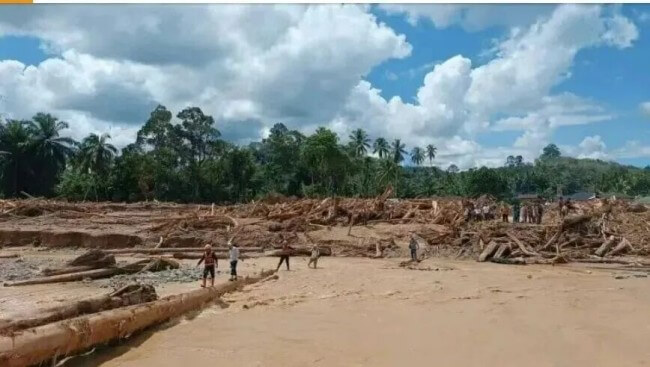
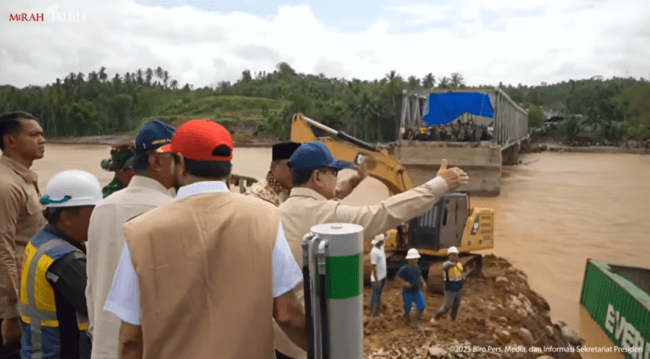
View Related ProductsCUPERTINO, Calif., Dec. 12, 2025 — When torrential rains devastated Aceh Province in early December 2025, millions of Indonesians wanted answers. Where was the flooding worst? What was the government doing to help? As homes vanished beneath floodwaters and infrastructure crumbled across the regencies of Aceh Tamiang and Bireuen, the nation’s eyes turned to one critical broadcast: President Prabowo Subianto’s frontline inspection on December 7.
The challenge wasn’t just documenting the disaster—it was transmitting a live, broadcast-quality signal from areas where the communication infrastructure itself had been swept away.
The media mission faced compounding technical obstacles that would have paralyzed traditional broadcast operations. Local cellular towers were damaged or overloaded, creating unstable “blind spots” throughout the disaster zone. The Presidential inspection required seamless handovers between ground convoy footage and aerial helicopter surveys—all while maintaining the high-definition clarity and minimal latency that state-level broadcasts demand. Traditional SNG (Satellite News Gathering) trucks proved ill-suited for this scenario, struggling to navigate flood-damaged roads and lacking the agility to follow a fast-moving Presidential convoy transitioning between land and air operations.
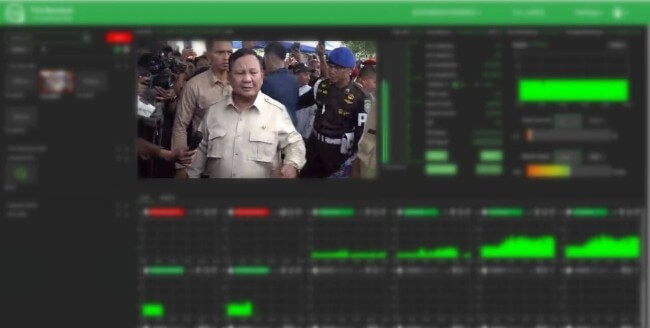
The national broadcaster and Presidential Palace media team deployed TVU Networks’ mobile IP transmission system. Instead of satellite trucks and fixed uplink positions, the team equipped both the ground convoy and the aerial helicopter with TVU One mobile transmitters—compact, cellular bonded units designed specifically for unstable network environments.
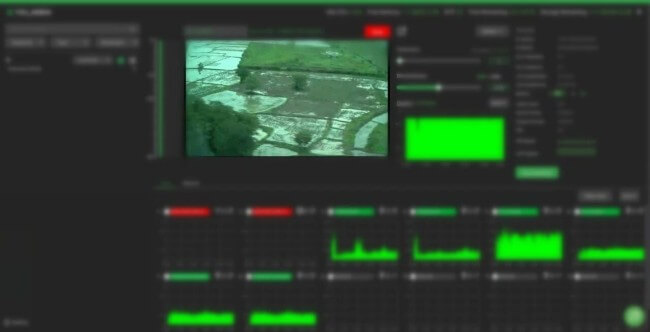
Using a remote production (REMI) workflow, signals were aggregated and transmitted directly from the field to TVU transceivers positioned in Jakarta studios hundreds of kilometers away. Production teams in the capital handled switching, commentary overlays, and broadcast graphics before distributing the feed simultaneously to the Presidential Palace YouTube channel and major national television networks. The advantages were immediate: minimal equipment weight, no setup delays, and the ability to maintain signal continuity even as the Presidential convoy moved rapidly between locations.
The broadcast’s success relied on three core technologies working in concert. The TVU One units employed TVU‘s ISX technology to bond multiple weak or unstable connections into a single robust uplink—simultaneously utilizing damaged local 4G networks and temporary emergency 5G infrastructure. When one network path degraded, ISX automatically shifted load to stronger connections without dropping the broadcast.
Using High Efficiency Video Coding (HEVC), the system achieved broadcast-quality HD transmission at roughly half the bandwidth of older compression standards. TVU’s Smart VBR (Variable Bitrate) implementation continuously monitored network conditions and adapted encoding parameters in real-time. During signal dips, the system automatically reduced bitrate to maintain connection continuity, then instantly restored high bitrate when bandwidth recovered.
The system’s Reliable Transport layer integrated Forward Error Correction (FEC) algorithms that proactively rebuilt lost data packets before they could cause visible artifacts. Unlike standard protocols that request retransmission—introducing delays incompatible with live broadcasting—FEC sent redundant data alongside the primary stream, allowing instant reconstruction of missing information. This eliminated the screen freezing and pixelation that typically plague cellular transmission in disaster zones.
The mission’s most demanding phase came when President Subianto boarded a helicopter for aerial surveys. As the aircraft climbed, descended, and banked over the flood zone, the TVU One unit experienced rapid cell tower handoffs, signal interference from rotor vibration, and Doppler frequency shifts. Network conditions fluctuated dramatically—from stable 5G coverage near the disaster relief center to virtually weak 4G signal in the flood-affected areas.
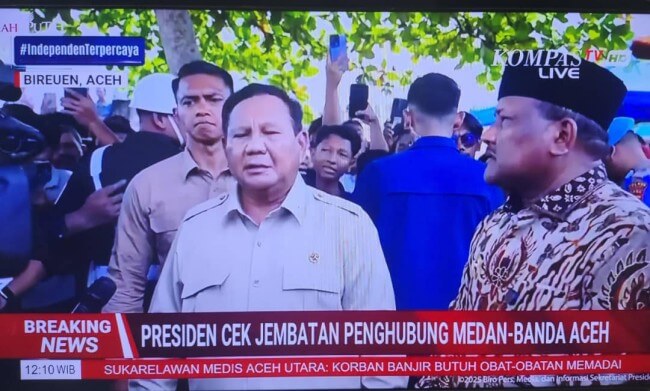
Yet the aerial feed remained stable and distinct throughout the flight. Viewers saw uninterrupted bird’s-eye footage of rescue operations, stranded communities, and the full extent of flood damage across dozens of square kilometers. The system’s performance under these extreme variables demonstrated the maturity of bonded cellular technology for mission-critical applications.
From muddy ground routes through flooded villages to aerial surveys 500 meters above Aceh, the broadcast maintained uninterrupted, broadcast-grade quality for over four hours. Millions of Indonesian viewers followed the Presidential inspection in real-time across both digital streaming platforms and linear television. By providing transparent, real-time coverage of government response efforts, the broadcast helped counter misinformation about the disaster’s scope and relief operations.
This deployment underscores a fundamental shift in how broadcast infrastructure responds to disasters. Traditional approaches assumed working telecommunications infrastructure and time to position heavy equipment. Modern disasters demand broadcast solutions as mobile and resilient as the events themselves. The convergence of bonded cellular technology, advanced video compression, and cloud-based production workflows now enables broadcast-quality transmission from locations that would have been technically impossible just five years ago.
Indonesia’s successful deployment during the Aceh floods demonstrates that mobile IP transmission can match traditional satellite broadcasting while offering greater flexibility, lower costs, and superior resilience in compromised infrastructure environments.
