TVU Networks introduces TVU One IP, a new all-IP transmitter designed for NDI, UVC and other IP-based sources, giving production teams a reliable way to send finished live programs without traditional SDI infrastructure....

TVU Cloud Production Powers Live Broadcast of the 2026 Suzhou Basketball Super League
TVU's cloud production platform helped Suzhou Radio and Television Station deliver its basketball league broadcast with a leaner, more efficient setup.
View Related ProductsOn the evening of July 10, the quarterfinals of the 2026 Suzhou Basketball Super League tipped off. Co-organized by the Suzhou Municipal Sports Bureau and Suzhou Radio and Television Station, the tournament runs under the slogan “Ten Districts, One Flame — Basketball Rules Suzhou,” spanning all ten districts of the city. The season features 59 games running from May through August. That night, the High-Tech Zone team traveled to face the Industrial Park team, grinding out a hard-fought four-quarter battle to open the playoffs with an 86–70 win.
For this broadcast, Suzhou Radio and Television Station built its production around a cloud workflow combining the TVU One 5G transmitter backpack with TVU Producer cloud production switcher, forming the technical backbone for multi-camera capture and live production. Alongside this, the station’s in-house engineering team built its own system for capturing and relaying in-game data, delivering real-time overlays such as the score and the 24-second shot clock. Together, the two systems formed the broadcast’s overall approach: cloud-based production paired with in-house data graphics.
Cloud Production: Multi-Camera Capture, Produced in the Cloud
Four TVU One units deployed courtside handled multi-camera signal capture, streaming each feed to the cloud in real time, where TVU Producer handled switching and program output. Directing, audio mixing, and graphics packaging all stayed at the station — no OB van or large production crew had to travel to the venue. The result was a lightweight model where the people stayed in the studio while production happened in the cloud.
This cloud production setup relies on four key capabilities:
Multi-network bonded transmission. TVU One uses TVU’s next-generation ISX bonded transmission technology, aggregating multiple networks and carriers — 5G, 4G, Wi-Fi — simultaneously. Combined with HEVC Smart VBR adaptive bitrate encoding and FEC forward error correction, it delivers stable, low-latency HD video even in venues with limited or fluctuating bandwidth.
Real-time coordination. Built-in VoIP two-way calling, paired with the TVU CC intercom system, lets camera operators on-site stay in constant contact with the director back at the station — no separate intercom hardware required — keeping multi-camera switching seamless.
Dual-layer architecture. The system splits into an RTIL real-time interaction layer and an ISSP high-quality production layer. RTIL runs at a lower bitrate with minimal latency for preview and voice communication, while ISSP — built on TVU’s proprietary IS+ protocol — carries a higher bitrate to preserve broadcast-grade picture quality.
Frame-accurate sync. TVU’s proprietary TimeLock technology aligns all signals down to the frame, ensuring every cloud-based switch and graphics overlay lands precisely on the correct timecode in the output signal.
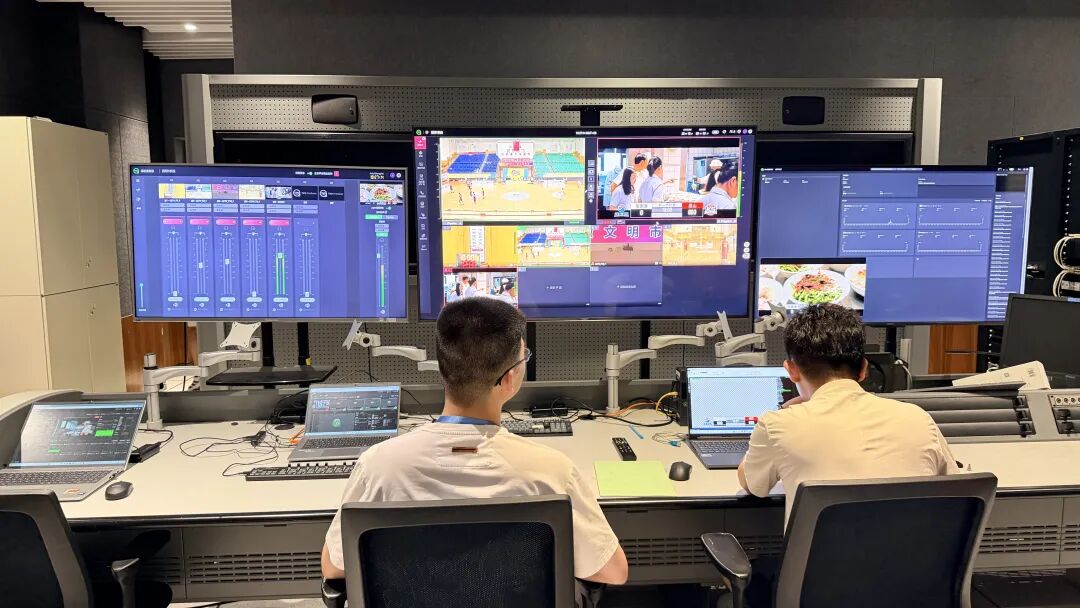
Built In-House: Game Data Capture and Signal Integration
Capturing scores, the shot clock, and other in-game data fell entirely to the station’s own broadcast engineering team, through a three-step process:
Real-time recognition. The production team used OCR (optical character recognition) to read the venue’s 24-second shot clock and scoreboard in real time — with no need to tap into the venue’s official data feed, making the system easy to deploy in almost any arena.
Cross-network relay. The captured data was relayed to the station’s in-house graphics system using intranet penetration technology. Since that system typically sits behind a firewall and isn’t reachable from the public internet, this step solved the cross-network handoff.
Signal integration. The finished graphics package was sent into TVU Producer via the NDI protocol, where it was synchronized and layered on top of the multi-camera feed in the cloud.
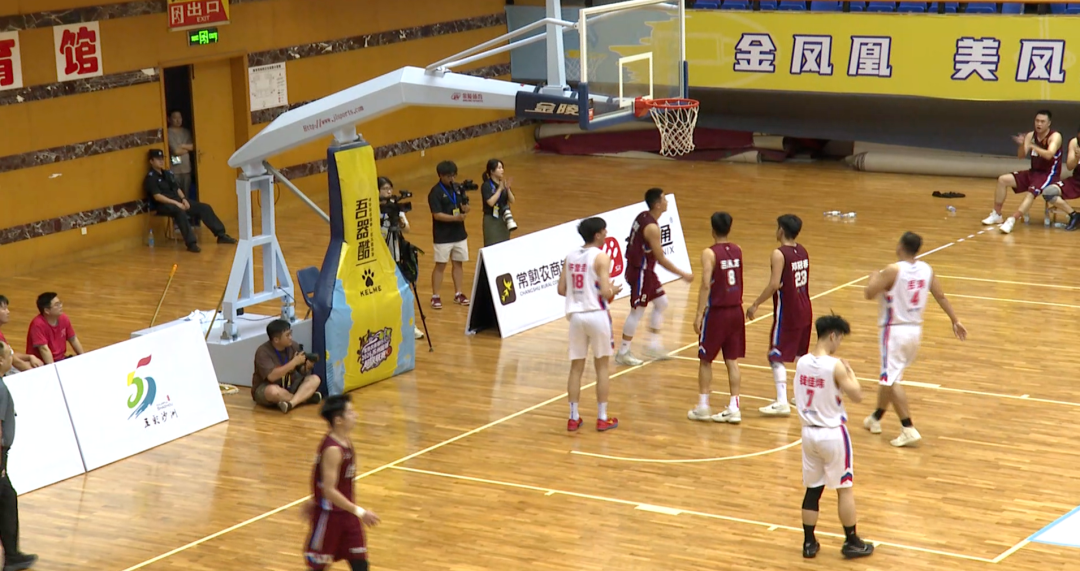
A Lightweight, Repeatable Production Model
The result on screen: four camera angles switching smoothly, with score and shot-clock data displayed accurately in real time. On the production side, the on-site footprint shrank to four backpack units and one in-house data-recognition system — no OB van, no large deployed crew required.
With this broadcast, Suzhou Radio and Television Station proved out a lightweight, repeatable production model: TVU’s cloud production handling multi-camera capture and switching, paired with OCR-based data capture and signal integration built in-house. The combination not only met the demands of this season’s packed schedule, but also points toward a practical way for broadcasters to cover more sporting events — and even breaking news or large-scale live events — without sacrificing production quality for efficiency.
